Two jobs, one set of cameras.
School surveillance does two very different jobs. From arrival to dismissal, the priority is the building envelope: who is coming through the main entrance, whether a side door is propped, whether someone is walking the fence line during recess. From evening to morning, and all weekend, the job is a quiet campus that should be empty apart from custodians and scheduled events.
Districts cover those jobs with a mix of people: a school resource officer, front-office staff buzzing visitors in, a district security desk, and often a contracted guard company or monitoring center for nights and weekends. Semaphor supports whoever is at the screen.
What school camera watchers look at.
During the school day
- The main entrance and vestibule. Visitors waiting to be buzzed in, and anyone who follows them through.
- Exterior doors. Side, gym and cafeteria doors that should stay closed and too often get propped.
- Drop-off loops and parking. Morning and afternoon traffic, and vehicles that stay after the loop clears.
- Perimeter and fields. Fence lines and open edges where an adult can walk onto campus unseen.
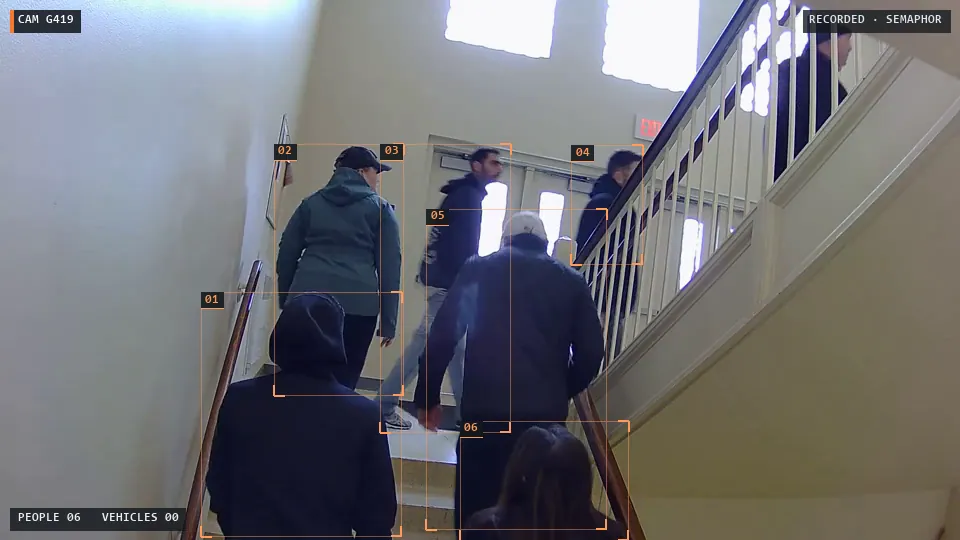
After hours
- Building exteriors and roof access. Vandalism, graffiti and break-ins.
- Parking lots. Cars that pull in after dark and sit, or loop the lot.
- Athletic facilities and portables. Areas far from the main building and poorly lit.
The nuisance side is enormous. During the day, hundreds of students moving between buildings are entirely normal. After hours, wind, sprinklers, animals and headlights on the road generate endless motion. What the team needs is a short list: a person at a door that should not be used, an adult on the field during class, someone on campus at midnight.
Privacy first, by design.
Schools are rightly careful about surveillance technology around children. Semaphor does not do facial recognition. Numbered tracks are per camera and exist only so a guard can follow a person across a clip — they do not identify anyone and do not follow students across cameras by identity. Semaphor describes what is happening in a scene, and the person at the console decides what, if anything, to do. See security and privacy for how evidence is handled and retained.
How Semaphor helps.
Schools rarely have budget or appetite for a new camera platform. Semaphor works with the camera software the district already runs, reading the monitoring screen rather than connecting to cameras. No rip-and-replace, no integration project with the access control vendor.
After hours, person and vehicle detection surfaces anyone on the campus cameras, and the alert reaches the guard immediately, followed by an AI scene report describing the activity. During the day, the views that matter most are the vestibule, specific exterior doors and the field fence; normal passing periods are something the person at the console clears at a glance. Every alert carries the original frames for review, so an administrator can see exactly what happened at the east door at 10:42.
What your team watches
- Main entrance vestibule and buzz-in line
- Side, gym and cafeteria doors
- Drop-off loops and parking lots
- Fields, fence lines and portables
- An empty campus overnight and on weekends
What Semaphor surfaces
- A person entering through a door that should stay closed
- A second person following a visitor through the vestibule
- An adult on the perimeter during the school day
- Any person or vehicle on campus after hours
- Evidence frames attached, no identity recognition
Working with guard companies and district desks.
Many districts contract overnight monitoring to a security guard company that watches several schools from one station. Semaphor lets that guard cover every campus view with focus instead of relying on tours to get lucky. For daytime entrance procedures, read our guide to tailgating at access doors; for overnight campus coverage, see after-hours trespassing.
Start with what Semaphor is. Then book a live demo on your own camera screens, or contact us about a pilot at a single school.
School monitoring FAQ
Does Semaphor use facial recognition on students?
No. Semaphor detects people and vehicles and describes activity. It does not identify individuals, and track numbers reset per camera clip.
Will it alert every time students change classes?
Daytime monitoring focuses on entrances and perimeter doors, where a person is worth a look, and duplicate suppression keeps repeat detections quiet. After hours, any person on campus is worth review.
Who decides what happens after an alert?
Always a person. The guard or staff member reviews the evidence and follows the district’s procedures. Semaphor never dispatches or contacts anyone on its own.