No quiet hours. No simple rules.
Most sites get easier to monitor after close. Hospitals never close. The emergency department is busiest at night. Shift change moves hundreds of staff through the garages and entrances. Visitors arrive at every hour, patients wander, ambulances back in, contractors work overnight. A rule like “any person after 10 p.m.” would bury the security console in alerts before midnight.
That is why hospital surveillance has always leaned on people. A security officer at the console knows the difference between a visitor looking for the elevator and someone who has been sitting in a stairwell for an hour. Semaphor is built to support that officer, not replace the judgment.
What the hospital security console watches.
A hospital security operations room typically has a video wall and one or two officers at the desk. The views that get attention:
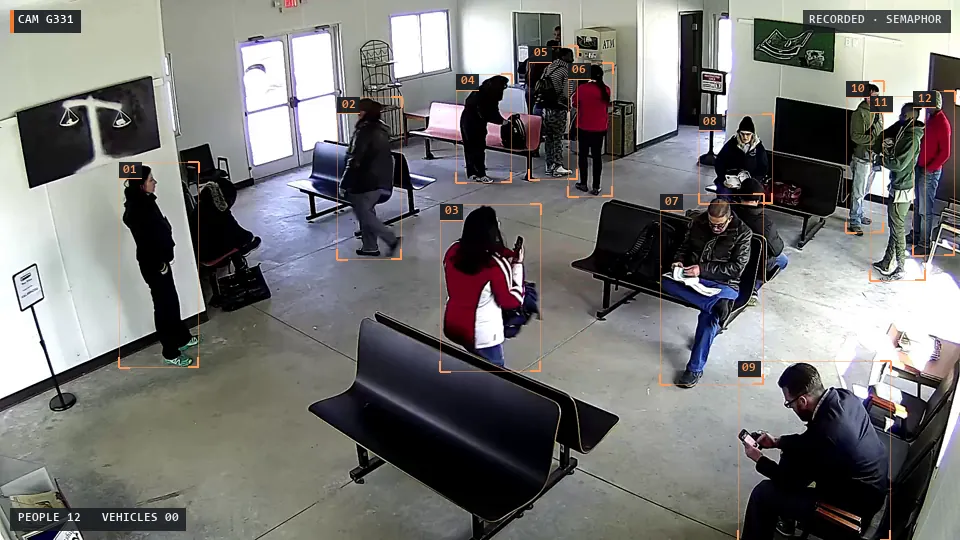
- Emergency department entrances. The walk-in doors, the ambulance bay and the triage waiting room.
- Parking structures. Levels, elevator lobbies, pay stations and the staff parking areas nurses walk to at 7 p.m. and 7 a.m.
- Stairwells and back corridors. Places people use to avoid being seen, and where staff can end up alone.
- Restricted areas. Pharmacy access, behavioral health unit doors, loading docks and the helipad access route.
- Perimeter entrances after visiting hours. Side doors that should be locked but get propped.
Hospital security teams take workplace violence seriously because staff face it directly, especially in emergency and behavioral health settings. The events that matter on camera are often subtle: a person pacing near the ED doors after being asked to leave, someone following a staff member to a car in the garage, a person in a stairwell long after anyone should be passing through, a door held open to a restricted corridor. The benign motion is endless: gurneys, wheelchairs, cleaning carts, visitors with flowers, ambulances, shift change.
Why hospital cameras are hard to monitor.
Hospital camera estates are large and built over decades, often with a mix of systems across buildings. Garages have deep shadow and headlight glare. ED entrances face bright glass and exterior light that swings between day and night. Stairwells are narrow, with people passing through quickly. And because there are so many cameras, tours cycle views on and off the wall constantly. Motion-based analytics are nearly useless here — everything moves.
How Semaphor supports the officer.
Semaphor reads the monitoring screen already on the security desk. No camera credentials, no connection to the clinical network, no new VMS. It works with existing camera software across the patchwork of systems most hospitals run.
Instead of alerting on every movement, Semaphor tracks people and vehicles on each view and lets the vision-language model write an AI scene report about what is actually happening: a person seated in a stairwell, someone lingering by a restricted door, a person moving between parked cars on a staff level. Alerts are sorted Critical, High, Unassessed and Low through alert prioritization, and the officer can override any priority. Tracking holds on still and seated people, which matters in waiting rooms and stairwells where the concerning person is often the one who is not moving.
Semaphor never contacts anyone on its own, never flags an individual by identity and never decides who is a threat. There is no facial recognition — track IDs are per camera. The officer reviews the evidence and decides whether to watch, send an officer to the scene or call for backup. That is human-in-the-loop security AI by design.
What your officers watch
- ED walk-in doors, ambulance bay and triage waiting
- Garage levels and staff parking at shift change
- Stairwells and service corridors
- Pharmacy, behavioral health and loading dock doors
- A wall of views cycling across several buildings
What Semaphor surfaces
- A person lingering at an entrance or restricted door
- Someone seated or waiting in a stairwell off-hours
- A person moving between parked cars on a staff level
- Activity at a side door after visiting hours
- Scene reports that say what is uncertain, not just what moved
Evidence for incident reports.
After a workplace violence incident, the security team has to produce a clear record fast. Semaphor keeps the original frames beside every AI assessment, hashed at capture, so the incident report starts from the actual images instead of an hour of scrubbing. Our guide on incident report video evidence covers what to keep.
Hospital security teams run like small GSOCs, and Semaphor fits that model. Learn what Semaphor is, then book a live demo on your own camera screens, or start a pilot on one console and measure it against a normal shift.
Hospital monitoring FAQ
Does Semaphor use facial recognition on patients or visitors?
No. Track numbers are per camera and do not identify anyone. Semaphor describes what is happening in a scene, not who a person is.
How does it handle constant motion in the ED and garages?
It focuses on people and vehicles, suppresses duplicate alerts and uses scene reports to describe behavior, so the officer sees events worth review rather than every movement.
Does Semaphor touch clinical systems or patient data?
No. It reads the security monitoring screen only. Contact us to walk through deployment with your security and IT teams.