What it is.
A detector can tell a guard that there is a person on camera 9. It cannot tell them that the person is trying door handles along a row of parked cars, or that they are a cleaner pushing a cart down the corridor they walk every night. That context is what turns an alert into a decision. Semaphor adds it with a vision-language model — an AI that reads images and writes about them in plain language. For every eligible event, the model reviews a short sequence of original frames plus the reason the event surfaced, and returns a structured scene report that lands on the guard’s alert card. It is the Analyze stage of the Semaphor loop.
What a scene report contains.
- Summary. One or two sentences on what is happening in the scene.
- Observations. Specific, checkable details: where people or vehicles are, what changed between frames, what they appear to be doing.
- Recommendation. A clear call for the guard — for example, guard review suggested, or no escalation — which feeds a suggested priority.
- Uncertainty. What the model could not determine: a figure too small to read, a view partly blocked, an action that could mean two things.
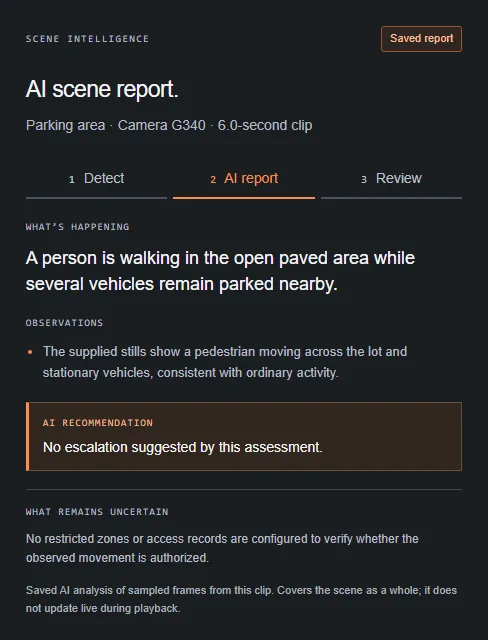
The uncertainty line is not an afterthought. A report that says “cannot tell whether the door was forced” is more useful to a guard than a confident guess, and it tells them exactly where to look.
Why it matters.
Faster triage, better calls.
Guards reviewing a stack of alerts want to know which ones are worth pulling up full screen. A written summary and recommendation beside each card lets them sort the routine from the unusual at a glance, and spend their attention where it counts.
Site context, not generic rules.
Post orders differ by site. Semaphor can pass the model a short site policy — for example, surface people near the service entrance after closing — so the recommendation reflects what matters at that property, not a generic definition of suspicious.
Evidence beside every claim.
The model’s report never stands alone. The original frames it reviewed sit right beside it on the card, hashed at capture. The guard can check every observation against the pixels. See evidence and audit trail.
How it works.
Package the event.
Semaphor collects the trigger reason, object positions, timestamps and a few original frames from the same camera episode, including context before and after.
Review with the model.
A Qwen VL-family model reviews the frames and a compact, ordered description of the event, and returns strict, validated JSON.
Update the card.
The report attaches to the existing alert card, labelled with the frames it examined, and suggests a priority the guard can accept or override.
The model runs where you want it. It can run locally on your own hardware, or on hosted inference reached over verified HTTPS with authentication and optional mutual TLS — see security and privacy. Each review starts with a fresh context and only the current incident summary carried forward, so reports stay focused on the event in front of the guard.
Because Semaphor uses alert-first review, the guard never waits for the report to see the alert. If the model is slow or unavailable, the card says so and the original evidence remains. Model output is supporting information: it is validated for structure, it cites only the evidence it was given, and it never dispatches, closes a card or overrides a guard. For a deeper look at the technology, read vision-language models for security cameras.
Where it matters.
- Retail stores — telling after-hours cleaning crews from someone who should not be on the sales floor.
- Hospitals — busy corridors and entrances where presence alone means little and context means everything.
- Self-storage — a vehicle parked by a unit at 2 a.m. is routine or not depending on what the people around it are doing.
You can read saved scene reports next to real research footage in the recorded demo.
Frequently asked questions.
Which AI model writes the scene reports?
Semaphor uses an open vision-language model from the Qwen VL family, running locally or on authenticated hosted inference. The model is configurable per deployment.
Can the AI scene report be wrong?
Yes, like any second opinion. That is why every report states its uncertainty and sits beside the original frames, and why the guard — not the AI — makes the call.
Can we tell the AI what matters at our site?
Yes. A short site policy, drawn from your post orders, is passed with each review so recommendations reflect that property’s rules.
Read scene reports written about your own cameras: book a live demo or start a pilot.