The garage problem: every level looks the same.
A parking structure is a stack of concrete decks, each with the same columns, the same painted stripes and the same fluorescent or LED fixtures. The cameras on level two look almost exactly like the cameras on level six. Put thirty of them on a monitoring grid and even an experienced operator has to squint to know which floor they are looking at.
That sameness is what car burglars count on. They move deck to deck, checking door handles and looking through windows, while the operator’s eyes are on the entry lanes. Semaphor is AI video monitoring assistance that watches every level at once and tells the operator exactly which view has someone in it.
What operators watch in a garage.
- Entry and exit lanes. Gate arms, pay stations and the ramps where tailgating and gate-running happen.
- Parking decks. Rows of cars under columns, the views where break-ins and catalytic converter theft occur.
- Stairwells. The path most people use to move between levels without being seen on the entry cameras. See our stairwells and corridors page for more on these views.
- Elevator lobbies. Where people wait, and where loitering and sleeping happen overnight.
- Roof deck. Often the least used level, the darkest at night and a gathering spot after hours.
- Pedestrian exits and bridges. Connections to offices, hospitals or hotels that the garage serves.
Break-in, or someone looking for their car?
Garages are full of people walking between cars. Most are looking for where they parked. The difference is in the pattern: a person who walks straight to a car and drives away is routine. A person who walks slowly down a row, stops at several vehicles, crouches beside one, or leaves the level on foot without driving out is the one to watch.
Other events that matter: a person in the stairwell for a long time, someone sleeping in an elevator lobby, a vehicle idling on the roof deck at 1 a.m., a group gathering on an empty level, and a person on foot walking up the vehicle ramp.
Nuisance activity: headlights sweeping across concrete, lights on occupancy sensors switching on and off, pigeons, rain blowing in at open sides and the same parked car sitting in view all weekend.
What your guards watch
- A grid of identical deck cameras across every level
- Stairwells and elevator lobbies nobody checks often enough
- Entry lanes that eat most of their attention
- Motion alarms from headlights and sensor-switched lights
What Semaphor surfaces
- A person walking a row and stopping at vehicles, on the exact pane
- Someone lingering in a stairwell or elevator lobby
- Vehicle activity on the roof deck after hours
- Original frames with hashes for the police report
Low light, sensor lighting and rotating grids.
Garages are hard on cameras. Many use occupancy-sensor lighting, so a level goes dim until someone walks in and then brightens, which trips every motion alarm on that floor. Low ceilings mean wide-angle lenses and heavy distortion at the edges. Open sides let in glare from the street and headlights. And because there are so many cameras, most dashboards rotate through pages of views.
Semaphor’s camera view tracking gives each view a visual identity using visual hashes, scene landmarks and a median background, so it knows level four stairwell from level five stairwell even as the grid rotates or the operator rearranges it. When a camera cycles off-screen, Semaphor marks it as unobserved instead of assuming the level was empty. The coverage gap becomes visible, not hidden.
Detection is driven by people and vehicles, not raw pixel change, so lights snapping on do not become alerts on their own. For more on overnight lighting, read our guide to night-time camera monitoring.
From alert to evidence.
When someone appears where they matter, an alert card arrives immediately in the inbox, then a vision-language model updates it with an AI scene report: what is happening, what it observed, whether guard review is suggested and what it could not confirm. Tracking keeps one person’s walk down a row as one numbered track, recovering it through short gaps behind pillars and parked cars.
Each alert keeps the original frame next to the AI assessment, with an exact SHA-256 hash for the police report or the insurance claim. The operator decides whether to dispatch the patrol officer, call police or keep watching. Garage owners who contract with a mobile patrol company can use those alerts to send the patrol to the right level the first time.
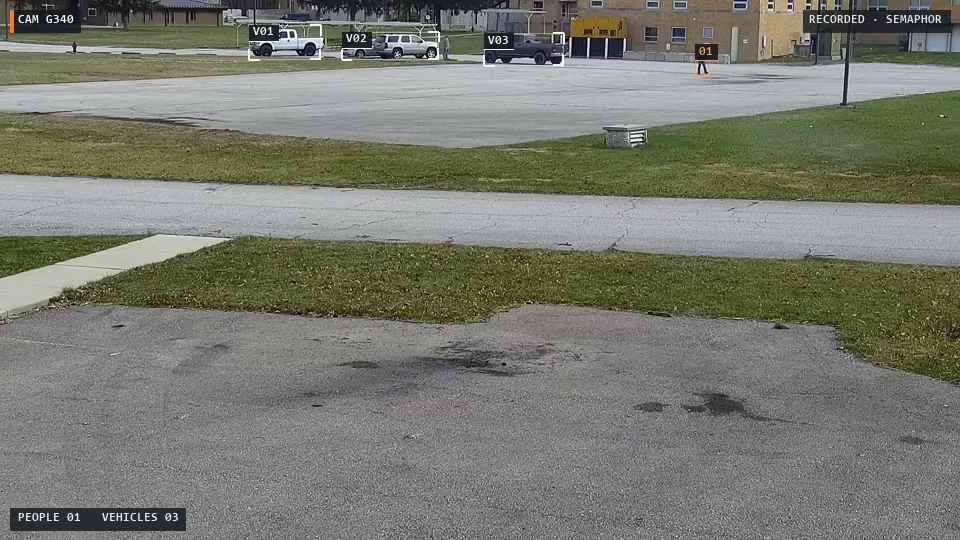
The still above comes from our recorded demo on the home page: a real parking area clip from public research footage, shown there with synchronized detection overlays, a track inspector and a saved AI scene report. Watch the recorded demo, then book a live demo on your own camera screens.
Start with your garage.
Start a pilot on one monitoring station and run it through a week of real traffic. We measure missed events, nuisance alerts and how quickly the operator gets to the right level.
Parking garage surveillance FAQ
Does Semaphor alert every time a car parks?
No. Vehicle activity is weighed with cooldowns and duplicate suppression, and the AI review describes routine parking so the operator can clear it immediately.
How does it know which level a camera is on?
Each view gets a visual identity from its own scene, and that identity follows the camera around the grid. Reading on-screen camera labels and building named landmark maps are in active development.
Does it use facial recognition?
No. People are tracked as numbered, per-camera tracks with no identity recognition.