What it is.
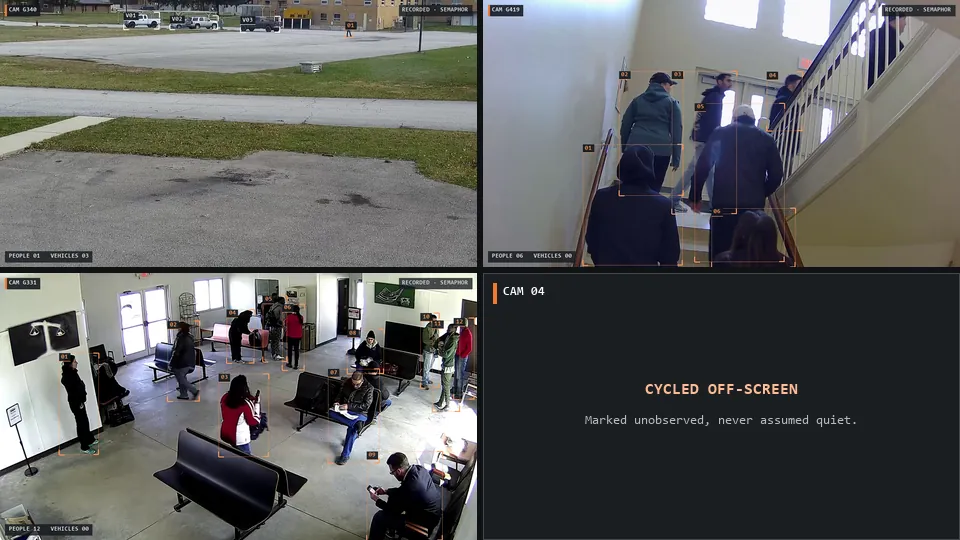
Working from the monitoring screen only works if you know which camera you are looking at. A screen is a mosaic of tiles that changes constantly: a VMS tour cycles through groups of cameras, an operator drags the loading dock to full screen, a client portal switches from a four-up to a nine-up. Camera view tracking is how Semaphor keeps its bearings. It separates the screen into camera panes, gives every view a visual feed identity, follows that identity as tiles move and resize, and records exactly when each camera was — and was not — on screen.
Why it matters.
Alerts that name the right camera.
An alert is useless if it points at the wrong tile. Feed identity means an alert from the rear gate is attached to the rear gate, whether that camera is in the top-left tile of a four-up or full screen on the second monitor.
History that follows the camera, not the tile.
When a cycling layout brings the parking lot back ten minutes later in a different position, Semaphor recognizes it as the same view. Cooldowns, duplicate suppression and open incidents carry on where they left off instead of starting fresh every time the wall cycles.
Coverage gaps you can see.
This is the part most systems get wrong. A camera that is not on screen is not being watched — by the guard or by any screen-based AI. Semaphor marks those periods as unobserved. It never treats a camera that cycled off the wall as quiet. Supervisors get an honest picture of real coverage, which is exactly what you need when deciding how many cameras to put on a wall or how long a tour should dwell.
How it works.
Separate the panes.
Geometric pane detection finds each camera tile by the gutters of the layout and crops it, keeping the original image.
Fingerprint the scene.
Each view is described by visual hashes, scene landmarks and a median background estimate, built from the scene interior so labels and clocks do not interfere.
Match and follow.
Returning scenes are matched to known feeds regardless of tile position or size. Uncertain matches stay unresolved instead of guessing.
Built for layouts that move.
Matching ignores where a tile sits on screen and focuses on what the scene contains: the fixed structure of the view — walls, doorways, poles, curbs — verified by landmark geometry and by visual hashes. A median background estimate suppresses people and vehicles passing through, so a busy moment does not make a familiar camera look new. A view that appears in a new tile, at a new size, or after a gap can match its existing feed.
Conservative on purpose.
When two cameras look nearly identical, or a match is weak, Semaphor keeps the observation unresolved and retains its images rather than merging it into the wrong feed. A new camera needs several consistent observations before it gets its own identity. Wrong identities are worse than slow ones, so the system errs toward saying “not sure.”
Honest timelines.
Each appearance of a camera is recorded as its own interval. Adjacent intervals are never silently merged, and footage is never invented across missing periods. Blank stretches in a camera’s timeline are unobserved time, not proof that nothing happened.
Camera label reading with OCR and named landmark maps are in active development to strengthen identity further — see what we’re building next.
Where it matters.
- Parking garages — many near-identical levels on a cycling tour, where knowing which level you are looking at is half the job.
- Schools — large camera counts rotated through a few monitors, with hallways that all look alike.
- HOA and gated communities — gate, pool and amenity cameras shuffled across a small guard-house screen.
Pan-tilt-zoom tours raise their own questions; see PTZ camera tours. For how tracking fits the whole pipeline, read how Semaphor works and how Semaphor works with existing camera software.
Frequently asked questions.
What happens when our video wall cycles cameras?
Semaphor recognizes each camera’s scene when it returns, even in a different tile or size, and continues its history. While a camera is off screen, it is marked unobserved.
Does Semaphor read the camera names on our tiles?
Camera identity today comes from the scene itself, not the label. Reading on-screen camera labels with OCR is in active development and available to pilot partners as early access.
What if two cameras look almost the same?
Semaphor stays conservative: if it cannot tell them apart, it leaves the observation unresolved and keeps the images, rather than merging two cameras into one.
Bring your busiest layout: book a live demo on your own camera screens, or start a pilot.