What it is.
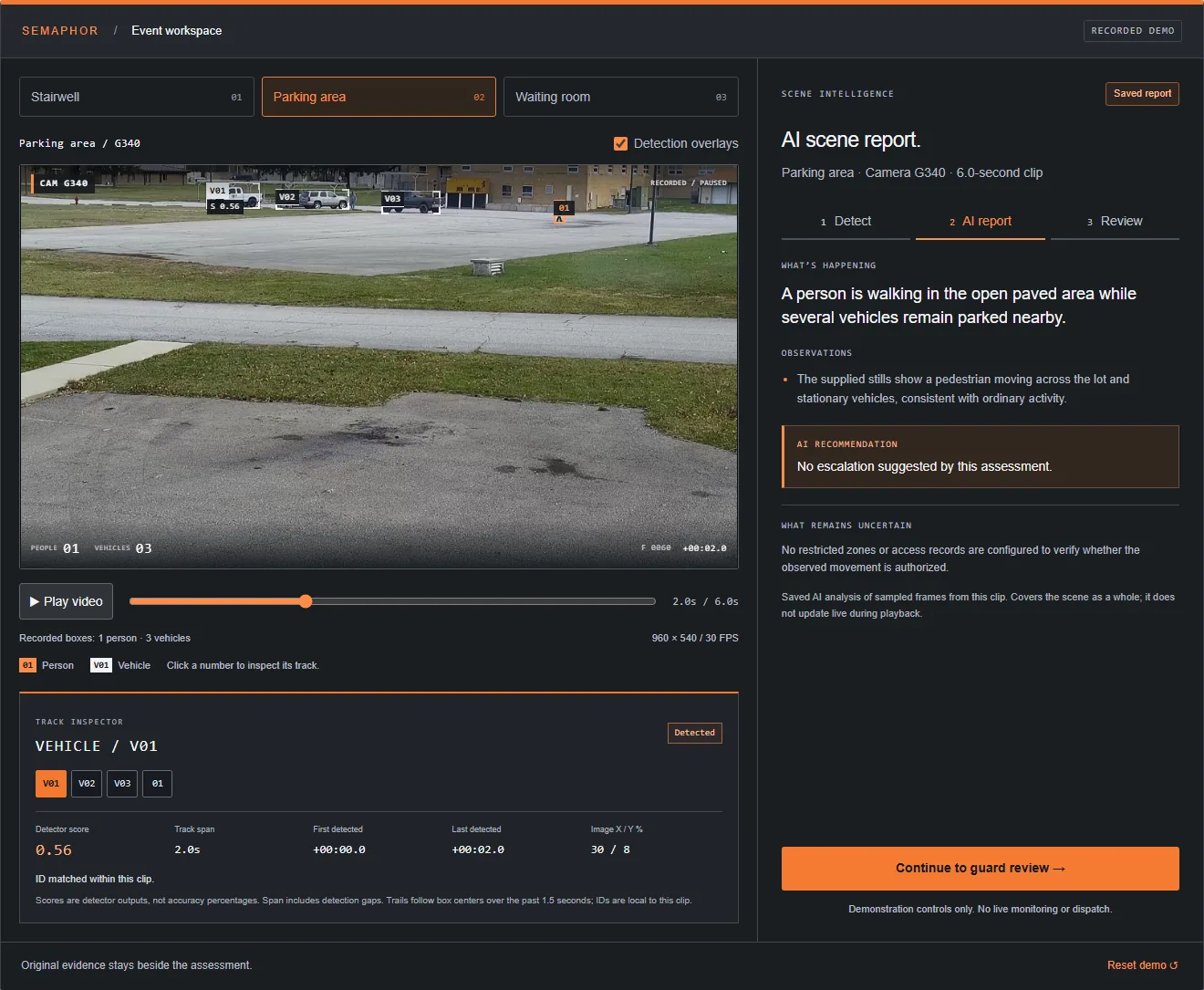
AI review takes time. A vision-language model reading several frames and writing a careful scene report cannot answer as fast as a detector can spot a person. Most systems make the guard wait for the slow part. Semaphor does not. In alert-first mode — what the engineering team calls progressive mode — a preliminary activity alert publishes to the guard inbox as soon as local detection finds an eligible event. The guard can open it and look at the camera evidence immediately. When the AI review finishes, it updates that same card with a scene report. One event, one card, two layers of information arriving at the speed each can deliver.
It is one of the design choices that sets Semaphor apart: guards never wait on AI to find out that something moved.
Why it matters.
Seconds count at the gate.
A person climbing a fence or a vehicle pulling up to a closed loading door does not pause while a model thinks. The guard needs to know now, with the frame in front of them, so they can pull the camera up full screen, start a talk-down or call the client. The explanation can follow.
One slow camera never blocks the others.
When several cameras light up at once — shift change at a warehouse, a crowd leaving an event — AI reviews queue up. In Semaphor, that queue only delays the scene reports. Every preliminary alert still lands on time, and each camera keeps being checked fairly.
No silent failures.
If the model is slow, overloaded or unreachable, the preliminary card stays in the inbox and says so. A failed AI review never declares a scene safe and never closes a card. The guard always has the original evidence.
How it works.
Local detection fires.
Person and vehicle detection or a substantial scene change proposes an event, and event routing confirms it is new.
The preliminary card publishes.
The card and its queued AI review commit together. The card shows the camera, time, trigger reason and original frames, marked Unassessed.
The AI updates the same card.
A separate worker runs the AI scene report and attaches it to the card, labelled with the frames it examined, and suggests a priority.
In backend tests on real camera frames, the preliminary alert reached the inbox in well under a second from the last frame. Detection runs in its own recyclable process; AI requests run separately and never hold up the loop. Each review has its own deadline, and pending reviews are ordered by priority, so a Critical card gets its report ahead of a Low one.
Guard decisions win.
The AI can raise a card’s priority when it sees something that merits attention, and newer evidence can raise it again. It never lowers a priority the guard set, never overrides a guard decision with a report about older frames and never closes a card. Only the guard closes the card. That rule is how human-in-the-loop security AI should work.
What the guard sees.
Immediately.
- Which camera, and when.
- Why it surfaced: person, vehicle or scene change.
- The original frames that triggered it.
- Status: Unassessed, AI review pending.
When the AI finishes.
- A plain-language summary of the scene.
- Specific observations and a recommendation.
- What remains uncertain.
- A suggested priority, clearly marked as AI.
Where it matters.
- Construction sites — after-hours intrusion where the difference between a talk-down and a stolen generator is how fast the guard sees it.
- Car dealerships — people moving between rows of inventory overnight.
- Warehouses and yards — vehicles arriving at gates and docks outside scheduled hours.
For how alerts should be ranked once they arrive, see security alert triage and priority levels.
Frequently asked questions.
Does the guard have to wait for the AI before seeing an alert?
No. The preliminary alert with its camera evidence appears first. The AI scene report is added to the same card when it is ready.
What if the AI model is down?
The preliminary card stays in the inbox and shows that the AI review is unavailable. The guard still has the original frames and can act on them. Nothing is closed or marked safe automatically.
Can the AI dismiss an alert on its own?
No. The AI can suggest or raise priority, but it cannot lower a guard’s decision or close a card. Only the guard closes alerts.
Watch a preliminary alert land on your own screens: book a live demo, or start a pilot on one monitoring station.