A hotel never closes, so the cameras never rest.
Most sites have a clear line between open and closed. A hotel does not. Guests check in at midnight, order food at 2 a.m., walk to their cars at 5 a.m. and leave luggage in the lobby all day. Housekeeping, engineering, room service and banquet staff move through service corridors around the clock.
The loss prevention or security officer watching the monitors, often while also answering the radio and walking rounds, has to separate the normal flow from the one situation that needs them. Semaphor is AI video monitoring assistance that watches every camera on that screen and moves the right one to the top.
What hotel security actually watches.
Lobby and front desk. Arrivals, a guest who becomes aggressive at the desk, unattended bags, someone who has been sitting in the lobby for hours without being a guest.
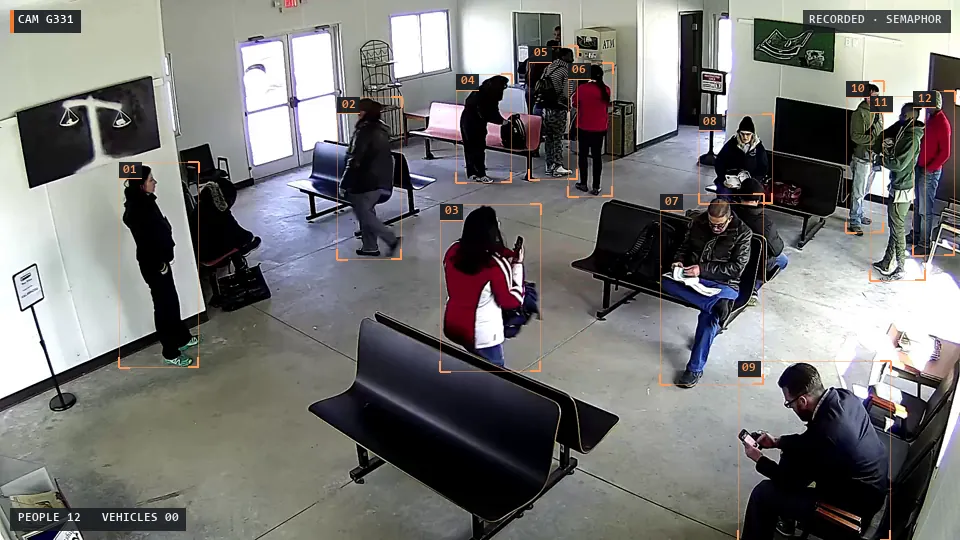
Parking lot or garage. Vehicle break-ins, people trying car doors, valet areas, and non-guests using the lot overnight.
Pool, fitness center and amenity decks. Posted hours matter. After closing, a person at the pool is both a security and a safety question.
Guest room corridors and elevator lobbies. Someone walking floor to floor trying doors, or lingering outside a room.
Back of house. Loading dock, receiving, kitchen exits, linen rooms and employee entrances. Theft of supplies and equipment often leaves this way.
Stairwells and exit doors. Propped fire exits and people using stairwells to bypass the lobby.
Normal hotel life versus real incidents.
Normal: a guest with luggage in the elevator lobby at 1 a.m. A room service cart parked in a corridor. Housekeeping moving between floors. Valets running cars. A delivery at the receiving door during the morning window.
Worth a look: a person on the pool deck after close. Someone walking the length of a guest floor and stopping at several doors. A person in a back-of-house corridor during the quietest hours. Somebody in the parking lot moving between cars instead of going to one. A person at the loading dock when receiving is closed.
What your guards watch
- A lobby camera that is always busy
- Guest floors, elevator lobbies and stairwells on rotation
- Parking cameras over a lot that is full all night
- Back-of-house corridors between their rounds
What Semaphor surfaces
- A person on the pool deck after posted hours
- Someone at the dock door while receiving is closed
- A person moving car to car in the lot, not the guest walking to theirs
- A scene report that says what is happening and what is uncertain
Camera and layout challenges in hotels.
Hotels tend to run a lot of cameras for the size of the security team. Corridor cameras all look alike, so a person on floor 6 and a person on floor 9 are hard to tell apart on a crowded grid. Pool and exterior views swing from bright sun to night lighting. Lobbies are glass-fronted and backlit. Many properties changed ownership or brand and inherited a mixed camera system displayed on one dashboard that rotates through pages.
Semaphor handles that without a new system. It works from the camera software you already run, separates each pane on the screen and follows cameras through page rotations using visual fingerprints and scene landmarks. When a camera cycles off-screen, Semaphor marks it unobserved rather than pretending it was quiet.
Context is what a hotel officer needs.
Because hotels are full of people, a bare “person detected” alert is noise. Semaphor pairs local person and vehicle detection with AI scene reports: a vision-language model describes the scene, lists what it observed, recommends guard review or no escalation and states what remains uncertain. The officer reads one sentence and knows whether this is a guest with an ice bucket or someone trying handles.
Cards arrive immediately and update in place when the AI finishes, so the officer never waits to know that something moved. Alert prioritization keeps the pool-after-close card above the busy lobby. The officer decides everything: whether to walk up, call the manager on duty or call police.
Guest privacy matters. Semaphor does not use facial recognition; tracks are numbered per camera and exist only as long as the clip. For documentation after an incident, see our guide to incident report video evidence. Properties that outsource security can run this through their security guard company.
See it on your property’s cameras.
Book a live demo on your own camera screens, or start a pilot on the security office monitor. Run it through a full weekend and see what it would have surfaced.
Hotel restaurants and back-of-house kitchens share the same after-hours risks as standalone venues. See AI camera monitoring for restaurants.
Hotel surveillance FAQ
Can Semaphor tell a guest from an intruder?
It doesn’t identify people. It describes behavior and context, such as a person on the pool deck after close or moving between cars, so the officer can make that judgment quickly.
Does it replace our fire alarm or door alarm system?
No. It works alongside your existing life-safety and access systems. Fire and smoke detection is in active development, with early access for pilot partners, and is meant to complement certified fire alarm systems.
Do we need to change our VMS?
No. Semaphor reads the monitoring screen your officers already use.