What loitering looks like on camera.
Most of the events guards are asked to catch are movements: a car pulls in, a door opens, someone climbs a fence. Loitering is the opposite. It is a person who arrives and does not leave. On a monitoring wall it looks like nothing much: a figure standing by an ATM vestibule, sitting on the steps of a closed store, leaning against a car in the back row, pacing slowly near a side entrance. The picture barely changes, and that is exactly why it gets missed.
The typical loitering patterns guards learn to recognize:
- Casing. A person who walks past an entrance, returns, stops and looks at doors, cameras or parked vehicles.
- Waiting to follow someone in. Standing near an access-controlled door until a resident or employee badges through. See tailgating at access doors.
- Sheltering. Someone settling in a stairwell, vestibule, garage corner or loading dock overnight.
- Lookout. A still figure near a vehicle or gate while others work out of view.
- Group gathering. A few people collecting in a parking lot or plaza after hours.
Not all of that is a threat, and much of it is not a crime. That is the first thing to get right.
Dwell vs presence: two different questions.
Commercial loitering analytics usually mean dwell time: a person remains inside a drawn zone longer than a set threshold, and an alarm fires. It sounds simple. In practice it depends on the system keeping track of the same person, continuously, for the whole period.
Presence is the simpler and more fundamental question: is there a person in this view right now, and has there been one for a while? For a guard, presence on a closed site is often enough on its own. Dwell timing only adds value when a person being there is normal and staying there is not, like a lobby, a transit stop or a storefront during the day.
Both break the same way. If the detector loses the person for a few frames, a naive tracker starts a new track when they reappear, and the dwell clock resets. A person who stands still for ten minutes can be reported as a string of short visits, or disappear from the alert entirely.
Why still and seated people are the hard case.
Detectors are trained mostly on people standing and walking. A person sitting on a bench, crouched beside a car, lying in a doorway or half hidden behind a pillar is a weaker signal, and scores drop in and out from frame to frame. Motion-based systems do worse still: once a person stops moving, they blend into the background model and vanish from the analytics. The quietest figure on the screen is the one the system forgets.
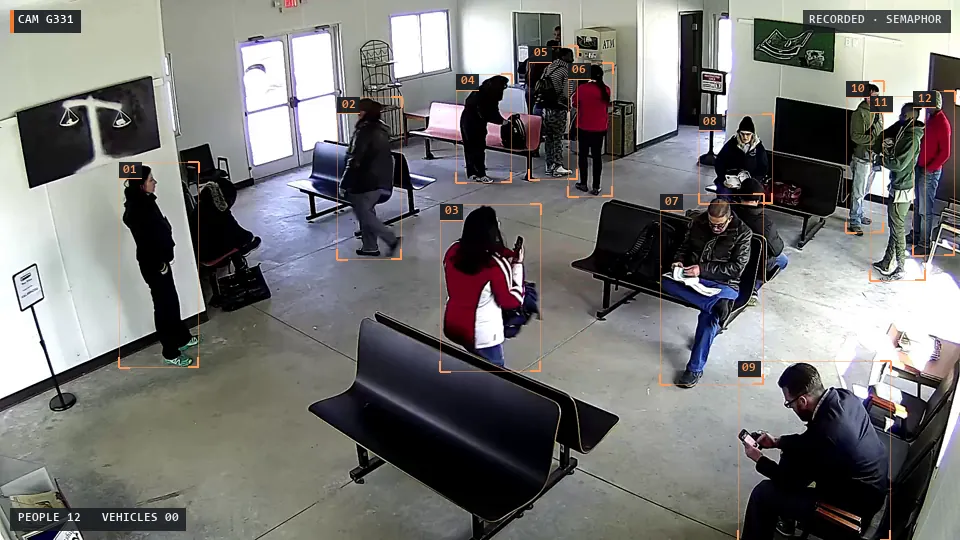
Good loitering monitoring needs tracking that holds a person through those gaps without inventing people who are not there. That is where Semaphor’s person and vehicle detection focuses its engineering. When an existing person track has no full-frame detection, a regional recheck runs the detector again on an expanded crop around where that person was. A fresh detection there, confirmed by pixel and color continuity and an unambiguous match, keeps the seated or still person supported. An empty region, changed clothing or a camera cut does not. Rechecks never create new people.
Who decides what counts as loitering.
This is the part vendors skip. Loitering rules are an operator decision, not a model decision. The same person on the same bench is a customer at 2 p.m. and a concern at 2 a.m. A teenager in the lobby is fine at one property and against house rules at another. Local law on loitering varies, and many clients do not want anyone approached for simply standing somewhere.
So write it into the post orders, per site:
- Which areas and which hours make presence worth a look.
- How long someone can remain before the guard reviews it.
- What the guard does: keep watching, talk down through audio, call the client contact, send a patrol, or call police.
- What is never an escalation: residents, staff, deliveries, people waiting for a ride.
Any automation, from a timer to a speaker announcement, should follow those rules and be signed off by the client. The guard applies judgment to the person on the screen.
Pick the zones
Entrances, ATM vestibules, stairwells, garage corners, the back of the building. Not the whole site.
Set the hours and limits
Agree with the client when presence is normal and how long is too long for each zone.
Review, then act
Guards review the evidence and follow the post order. Every decision is logged with the frames that drove it.
Where Semaphor fits.
Semaphor reads the camera screens your team already watches — no camera replacement, no new VMS; start with what Semaphor is. It surfaces people on each visible view, keeps numbered per-camera tracks through short gaps and rechecks still people instead of dropping them. Repeat activity updates the same open incident in the guard inbox instead of spamming new alerts, so a person who stays is one growing event with evidence attached. Track IDs are per camera, not identity: there is no facial recognition, which keeps loitering review about behavior and place, not who someone is.
You set the rules. The guard makes the call. See how it holds a seated person on the recorded waiting-room demo, or start a pilot on the entrances that matter to your clients.
Loitering detection FAQ
How does loitering detection work on security cameras?
The system detects people, tracks each one across frames and measures how long they stay in a defined area. If a person remains past a set time, an alert goes to the operator. The quality depends on keeping the same person tracked the whole time.
Why does loitering detection miss people who are sitting still?
Still, seated and partly hidden people produce weaker detections, and motion-based systems absorb them into the background. Rechecking the area where a known person was, instead of dropping the track, keeps them supported.
How long counts as loitering?
There is no universal number. It depends on the site, the hours, the client’s rules and local law. Set it per zone in the post orders and review it after the first weeks.
Does Semaphor automatically act on loitering?
No. Semaphor puts the person and the evidence in front of the guard. Rules, timers and any automated response are the operator’s decision; the guard decides what happens next.